How COVID-19 Accelerated Digital Transformation and Altered Software Consumer Behaviour
This compendium revolves around indicators of increased software demand, and how independent software vendors (ISVs) and their partner networks can sail through changing consumer behaviors and navigate emerging trends for the rest of 2021.
The statistics compiled here come from reputable research firms, and the insights expressed are guided by our 25 years of experience with the software industry. We’ll be updating its content periodically as new information becomes available.

[UPDATED AS OF 07 April 2021]
Is COVID-19 a Boon or Bane for Digital Transformation?
Even before COVID-19, the roles and responsibilities of chief information officers (CIOs) have been evolving for the past decade. These executives are most likely to play top roles in the digital transformation (DX) of organizations.1 Indeed, as the pandemic forced companies to realize that DX is paramount to success, IT business leaders get a more active role in high-level decision-making.2
The effects are being felt across different aspects in people’s professional, personal and social lives, and the massive efforts of governments to vaccinate their populations is not without its challenges from various aspects, such as production scaling, logistics, distribution, and mass inoculation. The good news is that most consumers are willing to take the jabs, suggesting that we could go back to the pre-pandemic way of life soon.
That is echoed by economic projections. According to the International Monetary Fund’s World Economic Outlook for April 2021, the global economy is expected to rebound: “Global growth is projected at 6 percent in 2021, moderating to 4.4 percent in 2022.”
That may or may not be good for software vendors, depending on which verticals they serve.
On a similar note, another report suggests that the global digital transformation market size is expected to grow from USD 469.8 billion in 2020 to USD 1009.8 billion by 2025 at 16.5% CAGR. In the forecast period, North America seems to remain the largest market (due to the “extremely open” nature of the market), but APAC is expected to grow the highest among the rest of the regions.
Even Gartner’s updated forecast expects IT spending could surpass USD4 trillion by 2022, which is higher than they initially expected, “as businesses focus more on digital initiatives and less on operational costs.”
Worldwide spending on DX:
BEFORE: ▲ To grow 17.1%3 CAGR (2019-2023), with spending to reach $2.3 trillion
AFTER: ▲ To grow 10.4% with spending to reach $1.3 trillion in 2020 alone4
Worldwide spending on the information & communications technology (ICT) industry:
BEFORE: ▲ To grow 3.6%5
AFTER: ▼ To decline 2.7%
Despite increased ICT industry consumer demand from the usual suspects7…
▲ Remote working | Teleconferencing | Distance learning | Telehealth | Delivery services | Media streaming | Online gaming
… there were massive consumer spending cuts in other industries, such as …
▼Tourism | Travel | Transportation | Recreation | Hospitality | Events

To put things into perspective, let’s look at an even more ironic situation — how spending projections for the healthcare industry fell, considering that COVID-19 is a health crisis that warrants big spending from both public and private sectors:

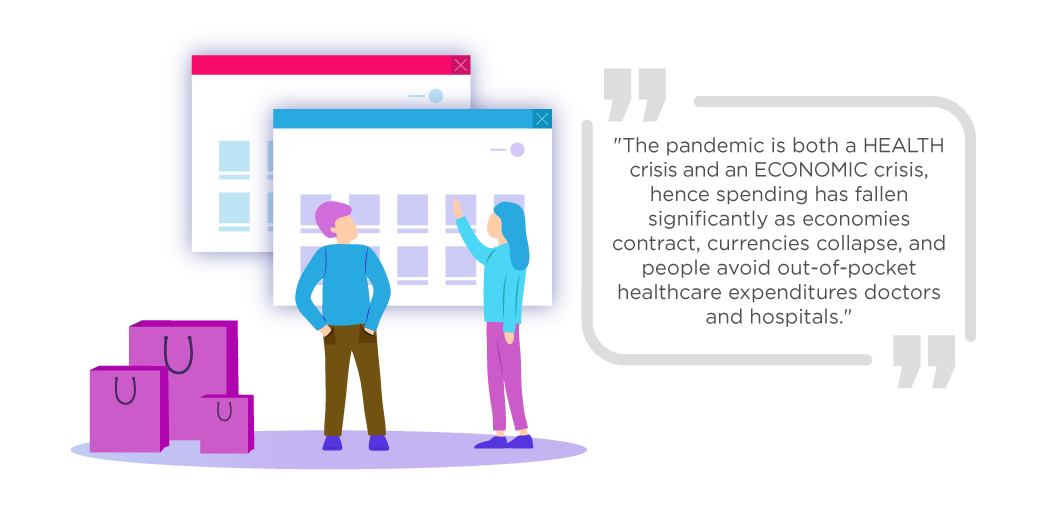
That is partly due to the fact that the pandemic is both a HEALTH crisis and an ECONOMIC crisis, hence spending has fallen significantly as economies contract, currencies collapse, and people avoid out-of-pocket healthcare expenditures for doctors and hospitals. The good news is that healthcare spending is expected to recover by H2 2020 moving forward.
On a brighter note, the pandemic has brought significant growth opportunities to other industries, such as e-commerce, online retail and fintech:
BEFORE: Online retail gets 16 billion global visits in January 202010
AFTER: Online retail gets 22 billion global visits by June 2020, up by 6 billion in just six months
Has Software Consumption Appetite Really Changed?
As you will remember when movement restrictions were enforced in H1 2020, consumers were anxious to spend on software, as questions emerged regarding what the “new normal” will look like. Such consumer anxieties were echoed by a valuation report11, where analysts found that 1 out of 4 companies in the software industry suspended their 2020 outlook because of COVID-19-related uncertainties. Interestingly, those with high expectations of recurring revenue only moderately adjusted their outlooks.
As you know by now, the initial shock of the lockdown has eased, but new buying behaviors linger.
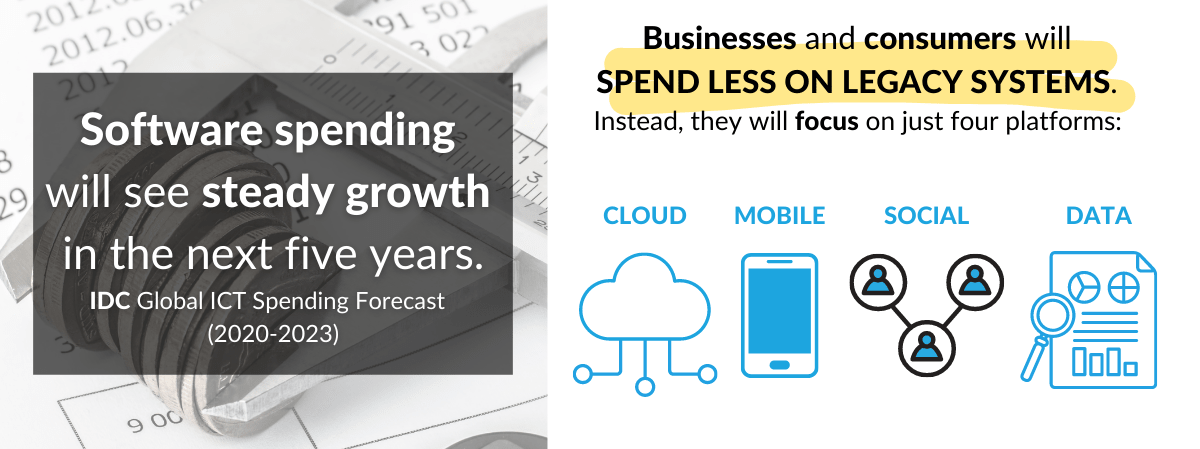
An IDC report13 suggests that software spending will see steady growth in the next five years. In this regard, businesses and consumers will SPEND LESS ON LEGACY SYSTEMS and focus on just four platforms: CLOUD, MOBILE, SOCIAL and DATA.
As one would have seen, software and online platform companies were able to adapt to disruptions with relative ease. Team collaboration platforms have quickly enabled workforces to stay productive. Distance learning platforms got kids through school, despite challenges. E-health solutions somehow made medical consultations doable from home. E-commerce and digital payments enabled shoppers to buy their goods without having to go to the supermarket. Social and entertainment platforms helped people through isolation.14
On the demand side, European companies tend to spend more per user than their North American counterparts, according to the European IT Spending & Staffing Benchmarks 2020/2021 executive summary by Computer Economics. The same report suggests they (Europeans) also “allocate more” to outsourcing service providers.
Some experts may argue that in terms of overall economic activity, “consumers are in limbo”.15 While that generally means less disposable money being spent, this seems to be temporary.

The from home Lifestyle
As an Accenture report puts it16, “living in the new” centers around the home, and it’s generally a good thing, when 8 out of 10 people with kids, and 6 out of 10 people without kids, now feel more connected to family. The idea is to get a holistic view of how the Coronavirus disrupted certain industries17, as we examine deeper how software consumption has changed since this from home lifestyle came to be.
Working from home
In the global workforce, around 2.7 billion (more than 4 out of 5 workers) have been affected by lockdowns and stay-at-home measures.18

Team collaboration and productivity suites: In just a week in March alone, Microsoft claims that Teams has added as many users as its rival Slack has in total, which is somewhere in the 12 million mark.19

Video Conferencing Apps: Since the start of the outbreak, we can see a huge growth in the use of video
conferencing:20 Zoom’s reported revenue is up by 169%,21 though the number of video calls done via Microsoft Teams is believed to be closing the gap in terms of overall usage.22

Cloud data management, data protection and virtual private networks: As work equipment and data leave the office premises, IT departments scrambled to heavily rely on these solutions, especially for compliance, network security and reliability.


SaaS23 and cloud-based solutions are poised for steady growth. A Gartner research estimates the figure at 19% in 2020 alone.24 The growth will mainly be driven by most organizations — especially large enterprises that rely heavily on on-premise infrastructure — adapting to securely bring work to and manage productivity from their employee’s home offices.
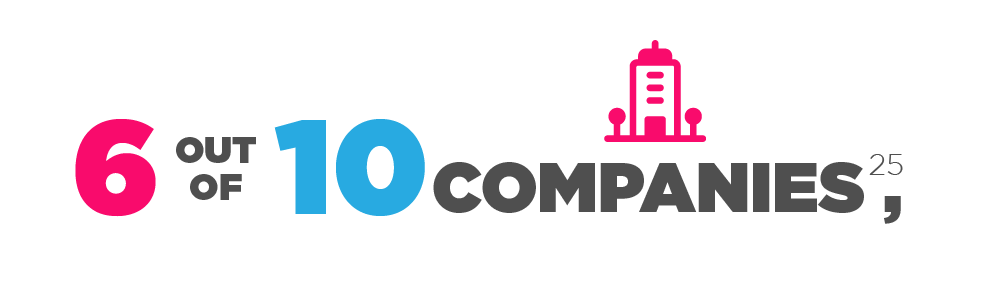
even the big names, have announced plans to make remote working a permanent option26 for their employees
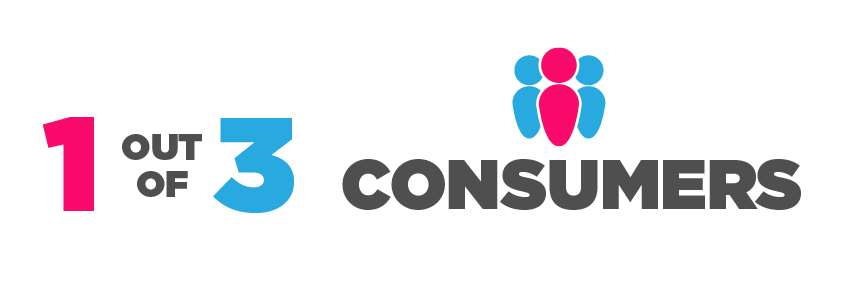
are willing to pay for solutions that help them work from home more effectively.27
Manufacturing:The global pandemic has indeed transformed this industry for good. Albeit the potential ubiquity of AI in automating manufacturing process, humans will remain the core decision-maker in the entire process. In line with this, there will be abundance of data, and that means the workforce across the board must be more data-literate than ever to remain competitive.
Industry 4.0:The demand for high-tech is especially bright28 from the manufacturing and supply chain management29 verticals, as industry leaders plan to adapt more high-tech into operations. That’s good news for ISVs targeting embedment into artificial intelligence (AI) and AR/VR. Even the robotics ecosystem will be accelerated.30
LEARNING from home
Back in Q4 2020, there were 132 country-wide school closures31(excluding those on academic breaks) and most governments have implemented some form of remote learning policy.32 Most countries are now doing a hybrid learning set-up, with schools accommodating on-site learning by “three days a week” schedules. Online schooling won’t seem to be a lasting trend though, as parents, students and teachers all over the world seem to agree that “the computer is no match for the classroom”, and that learning loss is real.

- Digital curricula across all education levels was the most common approach taken by most countries.
- Broadcast curricula (via television and radio) was also deployed, mostly to teach primary and lower secondary students.
- From the Deloitte survey, parents will be spending more on hardware — and therefore, software licenses — as they spend less on apparel and traditional school supplies.
- Parents want to invest in “digital resources” to supplement in-school education,33 since they are not very convinced that distance learning can fully replace the classroom experience.
- Blended learning approaches will be put to test.
- Educators may feel overwhelmed and under-equipped to teach remotely.
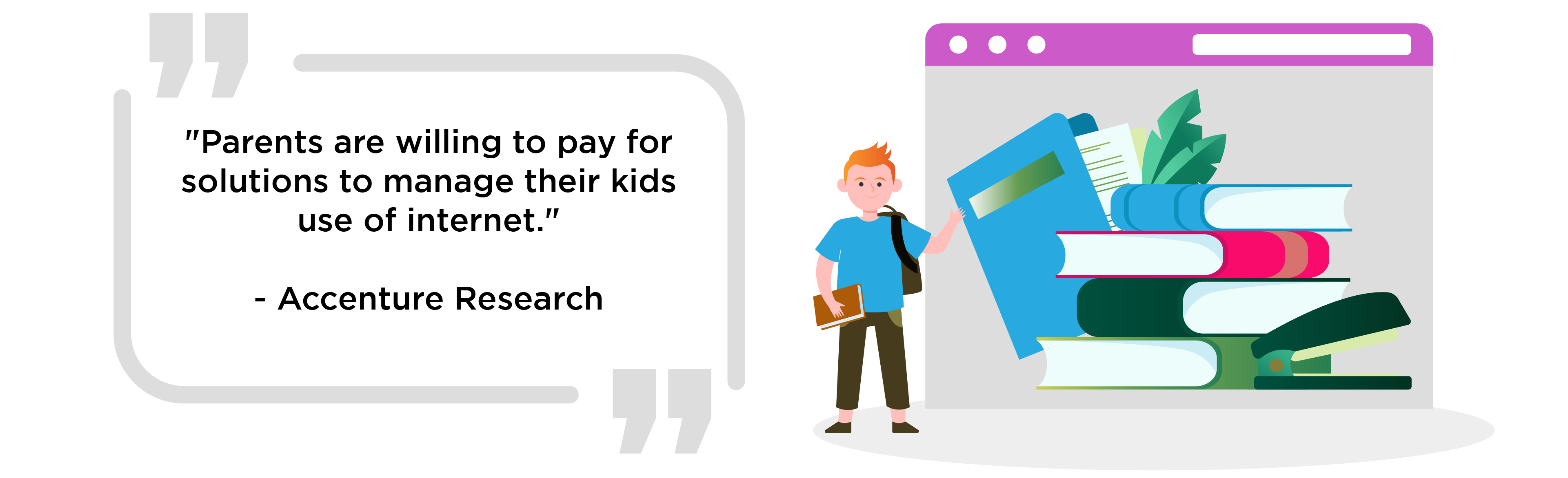
- Parents are willing to pay for solutions to manage their kids use of internet.27
- The user base for remote learning services grew by 120 percent.
Hybrid learning was the trend when schools re-opened last fall, and we can still remember how parents are anxious about sending their kids to school, citing health and financial concerns.33 However, according to a Pew research as of Q1 2021, recent developments suggest that academic concerns (ie the quality of learning and education) seems to be a bigger concern now than the health risk. Even the teachers themselves believed the effectiveness of instruction has declined in remote learning, according to this McKinsey chart.
HEALTHCARE from home
More people are relying on virtual health experiences,36 but they want more transparency and easy-to-digest data to guide their decisions.37

- People are getting used to using health apps, albeit usage in Europe is less common compared to more populous countries in Asia, such as China, India and Indonesia.
- The global telehealth market is predicted to surge at 14.8% CAGR from 2020 to 2030.38
- As health providers continue to build on digital capabilities, spending in healthcare IT is expected to increase by 12% in 2020 alone.38
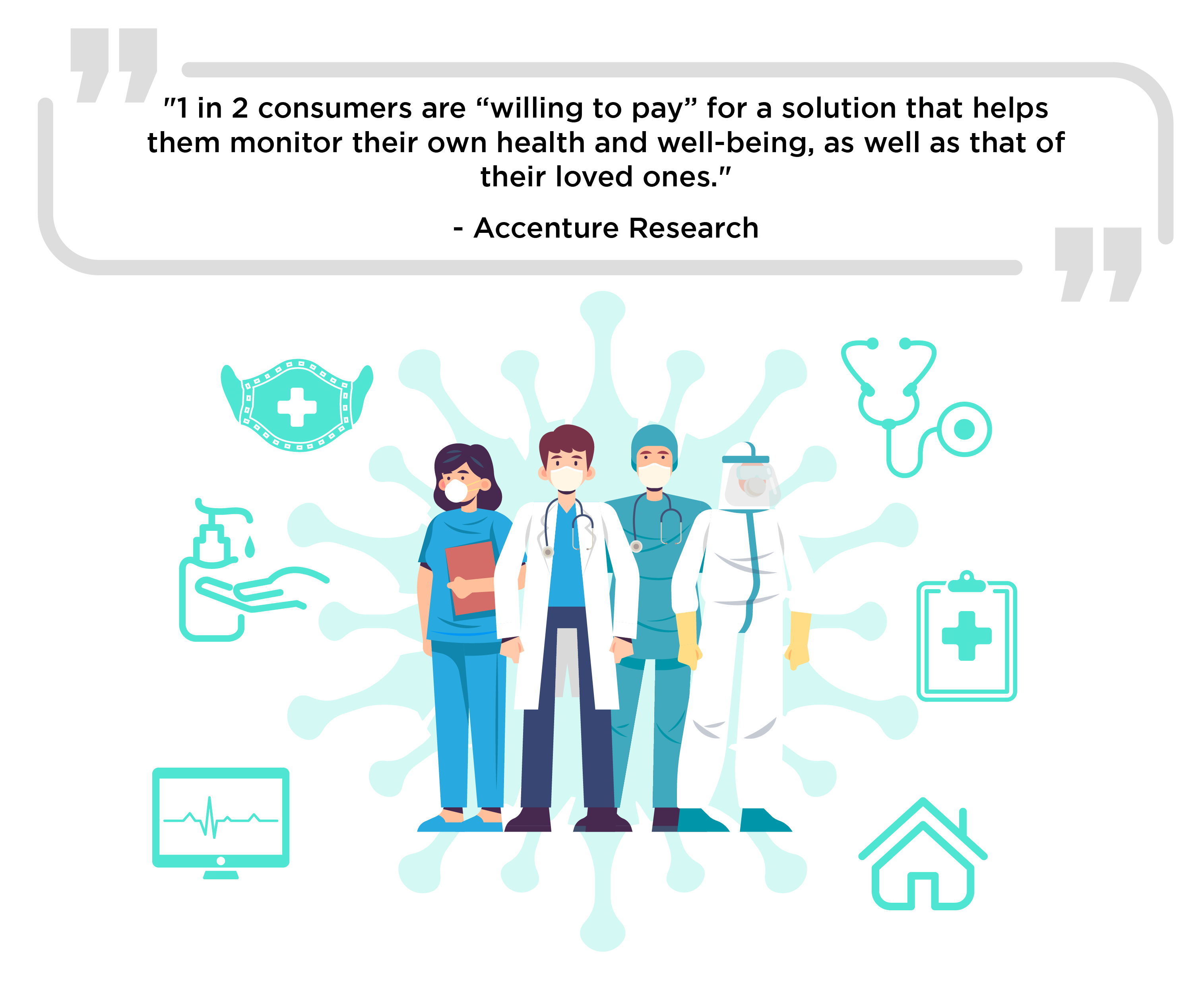
- 1 in 2 consumers are “willing to pay” for a solution that helps them monitor their own health and well-being, as well as that of their loved ones.27
- 1 in 2 consumers now use telehealth to replace in-person healthcare visits, and 3 out of 4 are interested in using the technology moving forward.39
- 1 in 3 consumers are expected to do, and continue doing, virtual consultations.40
- AI is seen to significantly cut time spent on routine, administrative tasks to free up to 70% percent of a healthcare practitioner’s time.41
- AI-powered software will play a role in health through “digital therapeutics” intervention.42
- Non-contact patient monitoring systems are beginning to gain huge acceptance from the healthcare industry, thanks to their ability to track different health parameters and provide data-driven insights without the need for actual clinic visits.43
- Multi-channel care delivery platforms are seen to facilitate more data-sharing for more efficient treatment, especially of chronic diseases such as diabetes.44

E-health record (EHR) solutions

Healthcare analytics

Health monitoring/tracking apps and wearables

Home healthcare apps

Hospital management systems


Medical databases and CRMs

Payer Services

Telemedicine

Blockchain-based healthcare data management
SHOPPING from home
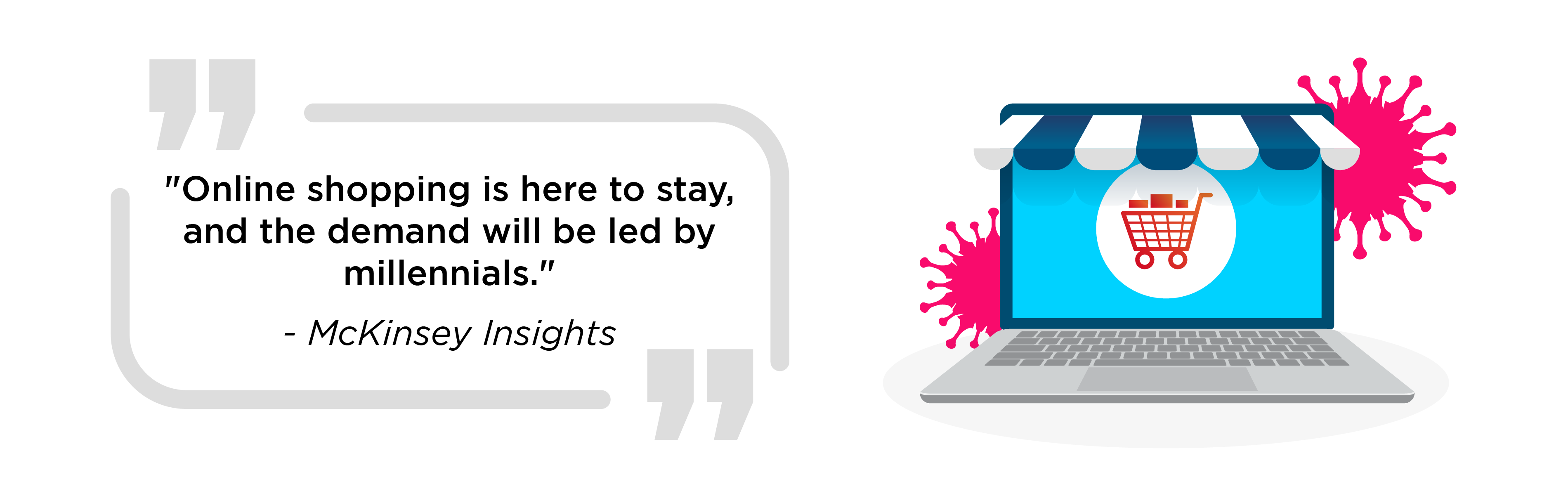
Despite an initial slump in H1 2020, online shopping is here to stay, and the demand will be led by millennials.45 People have spent on technology, mostly for work, school, health, and entertainment. Demand from the business side is also huge and ripe, as around 52% of all retail activities can be automated with existing technology.46
It’s 2021 Q1 and there seems to be no sign of this trend slowing down. In the UK, the preference for online shopping over in-store is seen to carry on, especially consumers aged 35 and older, even when the majority of the population gets vaccinated.

- Estimates suggest that business and consumer digital penetration have experienced 10 years worth of growth in less than three months.47
- For the shopper’s convenience, retailers are encouraged to use innovative in-store technologies, such as:
- Contactless payment systems
- AR systems (for trying out/testing products)
- Barcode scanner apps
- Location recognition
- E-commerce purchases are expected to increase 160% from new or low frequency users, and in under-penetrated categories, such as groceries.41
- Digital sales channels are poised for increased traffic and conversions, as most consumers shopping online for the first time will do it again, according to a consumer study by Accenture.27
- 89% thought digital interactions were equal or better than previous in-person experiences.
- 76% were satisfied with the results.
- 60% of consumers will feel either no or a small sense of loss if retail stores did not return.
- Digital service channels were rated by online shoppers as satisfactory, but they want more sophistication.
- 3 out of 4 parents will shop for back-to-school needs online due to concerns of health risks, and they seek retailers taking COVID-19 precautions.
ENTERTAINMENT from home
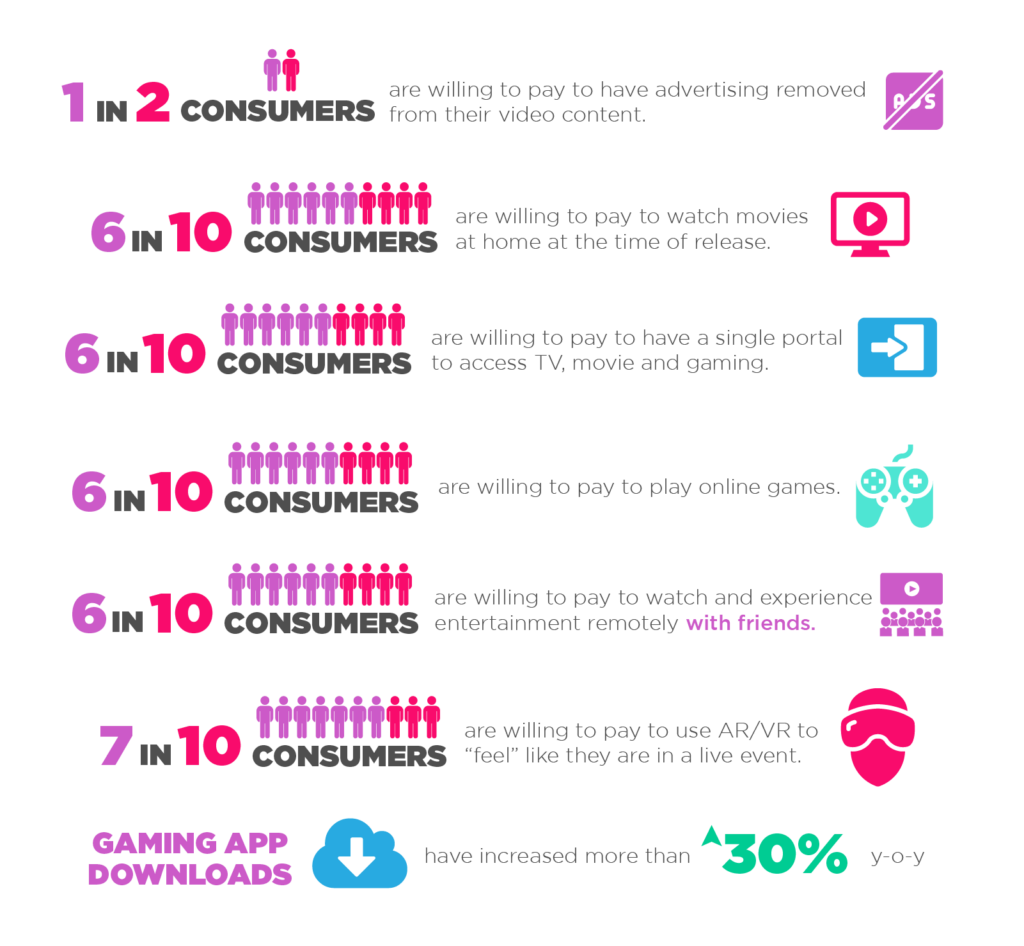
People have more time for leisure activities, consequently clocking in more usage of media streaming platforms, online gaming and social media. In fact, when it comes to consuming videos, a Wistia report claims that “consumers watched more than 23,000 years worth of videos in 2020.” Moreover, they are expected to spend more time on at-home activities, even when stricter restrictions are lifted.45 Interestingly, around 40% of new gamers agree that they will continue to spend more time and money on playing.


*Source: Accenture Comms and Media COVID-19 Consumer Study May 2020
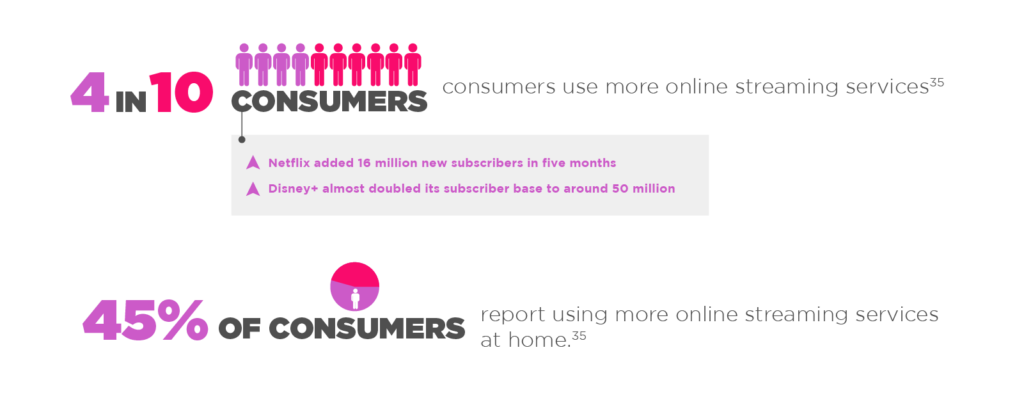
A McKinsey survey also cites similar trends:
Key Takeaways From An Industry-Level Perspective
Beyond the from home lifestyle, here’s how the demand looks like from activities that are used to be done “out of home”.
TOURISM, TRANSPORTATION, RECREATION, HOSPITALITY & EVENTS:
We’ve clustered these five industries here because of something they have in common — they all involve people being around people. Here are the opportunities of growth and threats of a slowdown:

⯅ People were anxious about casual dine-ins and quick-serve restaurants, and the food and beverage (F&B) businesses and in-home diners alike are quick to adapt, providing sustained demand and a surge in subscription to food delivery services.48
⯅ In particular, around 1 in every 2 consumers are expected to continue using in-app deliveries and home delivery apps for food, consumables and anything else.41
⯅ International travel isn’t expected to rebound anytime soon,49 though it’s starting to come back slowly, at least in APAC.50
⯆ People would choose to walk or bike, at least weekly, even after the pandemic.51
⯆ Usage of revenue management software is still declining, particularly the historical-analytics-based ticket pricing systems used by airlines,52 hotels and ride-hailing services.
⯆ Worldwide tourism is expected to drop by 58% compared to 2019, and with around 120 million tourism jobs at risk, the economic damage is likely to exceed $1 trillion in 2020 alone, merely from lost tourism spending.53
BANKING, FINANCIAL SERVICES & INSURANCE (BFSI) AND FINTECH
⯅ The potential value of AI for global banking could reach as high as $1 trillion, especially when around 60% of financial services respondents in a survey confirms they have embedded at least one capability somewhere in their platforms.54
⯆ In Europe, venture capital funding for fintech companies went from surplus to scarcity.

Opportunities In A Nutshell
Consumer behaviors and preferences have adjusted to the disruption brought about by the pandemic. Those new habits will stick, because even when more people get (or are willing to get) vaccinated (Pew Research) and the global economy recovers (at least in terms of global GDP), consumers aren’t very willing to “engage in normal activities” just yet (Gartner).
Your target market probably has the money (more disposable income) now anyway, according to McKinsey, and they are very eager to spend.
Whether or not the pandemic can open up new avenues of growth opportunities to ISVs and partners depends on how ready they are to position their offerings in response to rapidly changing consumer demand.
- DIGITAL is here to stay, despite some anxieties: As people spend even more time online,48 the digital lifestyle is generally poised for growth in the long-term, especially if these doubts are addressed:
- People want more transparency on how their data is processed, kept and used. This is especially true for the ever-rising popularity of digital payment gateways, where data privacy is more paramount.
- For those selling physical products online, shoppers want to be assured that hygienic measures were taken to process and deliver their orders.
- As IT leaders take a more prominent role in the executive table, expect better chances for more tech budget: Considering that not all IT budgets go to software alone, they may not necessarily go on a shopping spree right away, especially those who are still relying heavily on legacy systems. But for SaaS offerings, it’s a different story. In addition, a McKinsey survey found that more than 50% of business leaders plan large-scale changes in their organizations, and more “use of technology and systems” is high up on their list.49
- The post-pandemic workplace will be more “digitized and automated”: That’s what McKinsey found when they asked 800 business executives from various industries in US, Europe and Australia in September 2020.50 The survey results echo the trends we’ve compiled here:
- Remote working will be more permanent, especially in the finance and technology sectors. Make sure, though, that no one in your team gets left behind, because inclusion matters now more than ever.51
- More companies will accelerate their shift to AI and automation-reliant processes.

- Cloud is getting even bigger: Driven by the massive shift to remote working, distance learning, e-health options, online retail and on-demand entertainment (among others), SaaS is well-positioned to leverage this demand, which was gaining momentum even before COVID-19. ISVs must make sure their product development roadmaps and partner recruitment strategies align to the pandemic recovery policies of the verticals they target.

- Millennials will lead the shift to digital consumption: Using the right marketing contexts, software vendors shouldn’t have a hard time convincing these digital natives to “go digital”, especially when the doubts mentioned in # 1 are addressed:
- Focus on the customer experience: AI-powered chatbots are efficient and all, especially from the seller’s perspective, but nothing beats human touch. Not physically. In a B2B context, the more “human” assistance that business users can provide to their customers, no matter how contactless, the better. For ISVs partnerships, this is a good opportunity to consider embedding live chat and real-time, AR-enabled assistance and the like to expand your solution’s capabilities and feature sets.
- Make it “omni-channel”:52 6 in 10 millennials want a consistent experience (from their wearable to their smartphone, through to their laptop and even in physical stores).53 So, make the shopping experience as seamless as possible, from mobile to in-store touchpoints. If they want to “buy online, pick up in store”, give them the option.
- In the US alone, contactless mobile payments “will surpass” half of smartphone users by 2025 (eMarketer), thanks to them and the “next generation”.

- Don’t forget about Gen Z: As the first truly digital native generation enters the workforce, and accumulates disposable income, make sure they’re on your radar too.


Just because there is strong B2B and B2C demand doesn’t mean new customers will find you effortlessly. Remember that, at this moment, businesses are still rewriting their strategies, and possibly shortlisting a list of new suppliers and vendors:
- As businesses and consumers look for software solutions in marketplaces, now is even the best time to showcase your COVID-19-aligned value propositions to them.
- Account-based marketing is good, but clean up your target lists first, as your contact’s roles, responsibilities and companies may have already changed by this time.
- Do your market research. If you have one, make sure to update it. Or let marketing professionals do it for you. The more specialized they are with software marketing, the better.
- Make sure to partner with a marketing service provider with a proven track record.
We trust that this compilation of insights may serve as a guide when you make your software marketing and partner recruitment decisions. Business leaders echo most DX trends mentioned above anyway. If one were to ask Chief Information O ffcers and Senior IT Executives from large organizations in Q1 2020, they would have already expected a faster digital transformation even before COVID-19 struck anyway.54
With such drastic changes happening everywhere and in an instant, the world races to return to normalcy. The trends enumerated above may be temporary, and some permanent, but one thing is for sure: